
|
|
PAPCDFName:
![p(x;theta,p) = EXP(-theta) x = 0;
= EXP(-theta)*p**x*SUM[j=1 to x][(x-1 j-1)*(theta*(1-p)/p)**j/j!]
x = 1, ...; 0 < p < 1; theta > 0](eqns/pappdf.gif)
with The cumulative distribution function is computed using the following recurrence relation (from page 379 of Johnson, Kemp, and Kotz)
![p(x+1;theta,p) = (theta*(1-p)/(x+1))*SUM[j=0 TO x][(x+1-j)*p**(x-j)*
p(x;theta,p)]](eqns/papcdf.gif)
<SUBSET/EXCEPT/FOR qualification> where <x> is a non-negative integer variable, number, or parameter; <theta> is a positive number or parameter that specifies the first shape parameter; <p> is a positive number or parameter that specifies the second shape parameter; <y> is a variable or a parameter where the computed Polya-Aeppli cdf value is stored; and where the <SUBSET/EXCEPT/FOR qualification> is optional.
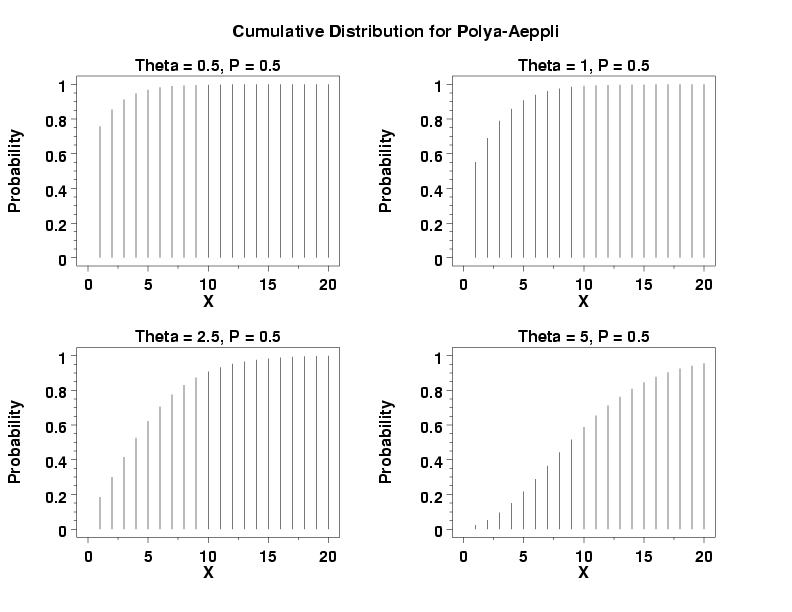
LET Y = PAPCDF(X1,2,0.3) PLOT PAPCDF(X,2,0.3) FOR X = 0 1 20
Evans (1953), "Experimental Evidence Concerning Contagious Distributions in Ecology", Biometrika, 40, pp. 186-211. Johnson, Kotz, and Kemp (1992), "Univariate Discrete Distributions", Second Edition, Wiley, pp. 378-382.
title size 3
tic label size 3
label size 3
legend size 3
height 3
multiplot scale factor 1.5
x1label displacement 12
y1label displacement 17
.
multiplot corner coordinates 0 0 100 95
multiplot scale factor 2
label case asis
title case asis
case asis
tic offset units screen
tic offset 3 3
title displacement 2
y1label Probability
x1label X
.
ylimits 0 1
major ytic mark number 6
minor ytic mark number 3
xlimits 0 20
line blank
spike on
.
multiplot 2 2
.
title Theta = 0.5, P = 0.5
plot papcdf(x,0.5,0.5) for x = 1 1 20
.
title Theta = 1, P = 0.5
plot papcdf(x,1,0.5) for x = 1 1 20
.
title Theta = 2.5, P = 0.5
plot papcdf(x,2.5,0.5) for x = 1 1 20
.
title Theta = 5, P = 0.5
plot papcdf(x,5,0.5) for x = 1 1 20
.
end of multiplot
.
justification center
move 50 97
text Cumulative Distribution for Polya-Aeppli
Date created: 6/20/2006 |
 and p denoting the shape parameters.