
|
|
LOSPDFName:

with p and r denoting the shape parameters. The r parameter is restricted to non-negative integers. This distribution is used to model the "gamblers ruin" problem. For this problem, p is the probability that the gambler loses one unit (1 - p is the probability that the gambler wins one unit). The value of r is the number of units the gambler starts with. The lost games distribution is then the distribution of the number of games lost until the gambler loses all of his fortune. This problem is referred to as the gambler's ruin since if the probability of winning is less than 0.5, the gambler will eventually lose all of his fortune with probability 1.
Although this distribution was developed to model gambling,
Kemp and Kemp demonstrated its applicability to a number of
other important applications. For example, Haight used it
to model the queue with r initial customers, where new
customers arrive according to a homogeneous Poisson process
with shape parameter
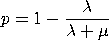 . .
Note that Haight use the parameterization 
Assuming a constant service time (rather than an exponential service time) results in the Borel-Tanner distribution.
<SUBSET/EXCEPT/FOR qualification> where <x> is a positive integer variable, number, or parameter; <p> is a number or parameter in the range (0.5,1) that specifies the first shape parameter; <r> is a number or parameter denoting a positive integer that specifies the second shape parameter; <y> is a variable or a parameter where the computed lost games pdf value is stored; and where the <SUBSET/EXCEPT/FOR qualification> is optional.
LET Y = LOSPDF(X1,0.7,2) PLOT LOSPDF(X,0.6,5) FOR X = 5 1 50
LET R = <value> LET P = <value> LET Y = LOST GAMES RANDOM NUMBERS FOR I = 1 1 N
LOST GAMES PROBABILITY PLOT Y
LOST GAMES CHI-SQUARE GOODNESS OF FIT Y To obtain the maximum likelihood estimate of p assuming that r is known, enter the command
LOST GAMES MAXIMUM LIKELIHOOD Y2 X2 The maximum likelihood estimate of p is

with For a given value of r, generate an estimate of p based on the maximum ppcc value or the minimum chi-square goodness of fit with the commands
LET P1 = <value> LET P2 = <value> LOST GAMES KS PLOT Y LOST GAMES KS PLOT Y2 X2 LOST GAMES KS PLOT Y3 XLOW XHIGH LOST GAMES PPCC PLOT Y LOST GAMES PPCC PLOT Y2 X2 LOST GAMES PPCC PLOT Y3 XLOW XHIGH The default values of P1 and P2 are 0.51 and 0.95, respectively. The value of R should typically be set to the minimum value of the data. Due to the discrete nature of the percent point function for discrete distributions, the ppcc plot will not be smooth. For that reason, if there is sufficient sample size the KS PLOT (i.e., the minimum chi-square value) is typically preferred. Also, since the data is integer values, one of the binned forms is preferred for these commands.
Kemp and Kemp (1968), "On a Distribution Associated with Certain Stochastic Processes", Journal of the Royal Statistical Society, Series B, 30, pp. 401-410. Haight (1961), "A Distribution Analogous to the Borel-Tanner Distribution", Biometrika, 48, pp. 167-173. Johnson, Kotz, and Kemp (1992), "Univariate Discrete Distributions", Second Edition, Wiley, pp. 445-447.
let r = 3
let p = 0.6
let y = lost games random numbers for i = 1 1 500
.
let y3 xlow xhigh = integer frequency table y
class lower 1.5
class width 1
let amax = maximum y
let amax2 = amax + 0.5
class upper amax2
let y2 x2 = binned y
.
let k = minimum y
lost games mle y
let p = pml
lost games chi-square goodness of fit y3 xlow xhigh
relative histogram y2 x2
limits freeze
pre-erase off
line color blue
title Lost Games MLE FIt: Phat = ^pml (r = ^r)
plot lospdf(x,pml,r) for x = r  1  amax
title
limits
pre-erase on
line color black
.
label case asis
x1label P
y1label Minimum Chi-Square
let p1 = 0.5
let p2 = 0.9
lost games ks plot y3 xlow xhigh
let p = shape
case asis
justification center
move 50 5
text P = ^p
lost games chi-square goodness of fit y3 xlow xhigh
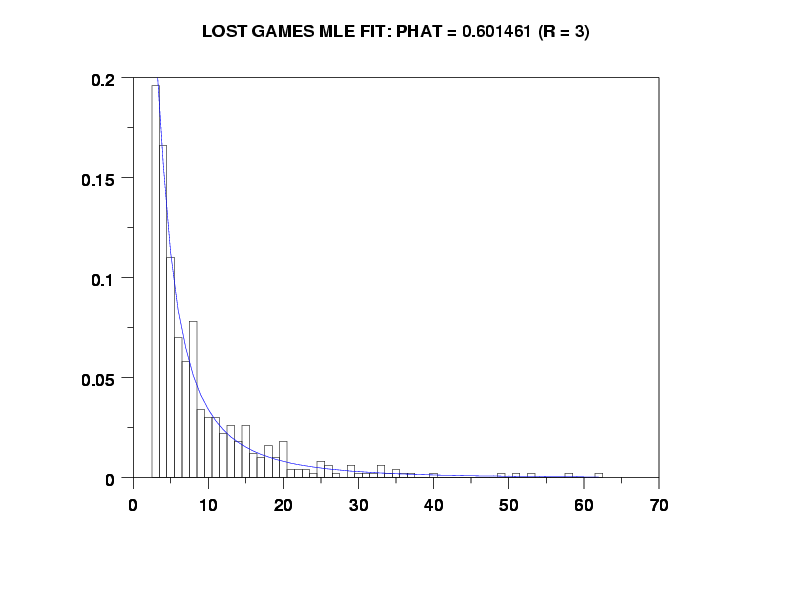
           LOST GAMES MAXIMUM LIKELIHOOD ESTIMATION:

 NUMBER OF OBSERVATIONS                   =      500
 SAMPLE MEAN                              =    8.892000
 SAMPLE STANDARD DEVIATION                =    8.214822
 SAMPLE MINIMUM                           =    3.000000
 SAMPLE MAXIMUM                           =    62.00000

 ESTIMATE OF R                            =    3.000000
 MAXIMUM LIKELIHOOD ESTIMATE OF P         =   0.6014611

 THE MAXIMUM LIKELIHOOD ESTIMATES FOR R AND P
 ARE SAVED IN THE INTERNAL PARAMETERS RML AND PML


 THE COMPUTED VALUE OF THE CONSTANT P        =   0.6014611E+00


                   CHI-SQUARED GOODNESS-OF-FIT TEST

 NULL HYPOTHESIS H0:      DISTRIBUTION FITS THE DATA
 ALTERNATE HYPOTHESIS HA: DISTRIBUTION DOES NOT FIT THE DATA
 DISTRIBUTION:            LOST GAMES

 SAMPLE:
    NUMBER OF OBSERVATIONS      =      500
    NUMBER OF NON-EMPTY CELLS   =       24
    NUMBER OF PARAMETERS USED   =        2

 TEST:
 CHI-SQUARED TEST STATISTIC     =    22.46355
    DEGREES OF FREEDOM          =       21
    CHI-SQUARED CDF VALUE       =    0.626767

    ALPHA LEVEL         CUTOFF              CONCLUSION
            10%       29.61509               ACCEPT H0
             5%       32.67057               ACCEPT H0
             1%       38.93217               ACCEPT H0

       CELL NUMBER, LOWER BIN POINT, UPPER BIN POINT, OBSERVED FREQUENCY, AND EXPECTED FREQUENCY
       WRITTEN TO FILE DPST1F.DAT
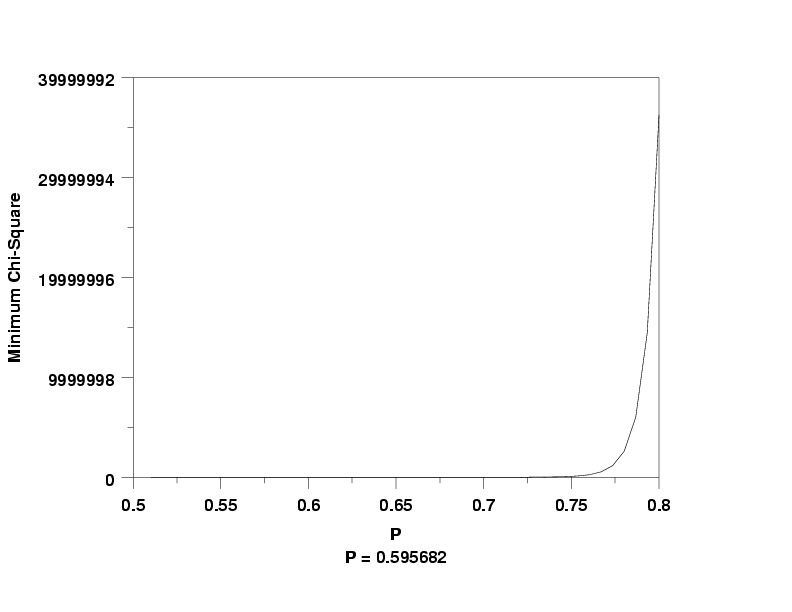
                   CHI-SQUARED GOODNESS-OF-FIT TEST

 NULL HYPOTHESIS H0:      DISTRIBUTION FITS THE DATA
 ALTERNATE HYPOTHESIS HA: DISTRIBUTION DOES NOT FIT THE DATA
 DISTRIBUTION:            LOST GAMES

 SAMPLE:
    NUMBER OF OBSERVATIONS      =      500
    NUMBER OF NON-EMPTY CELLS   =       24
    NUMBER OF PARAMETERS USED   =        2

 TEST:
 CHI-SQUARED TEST STATISTIC     =    21.82713
    DEGREES OF FREEDOM          =       21
    CHI-SQUARED CDF VALUE       =    0.590470

    ALPHA LEVEL         CUTOFF              CONCLUSION
            10%       29.61509               ACCEPT H0
             5%       32.67057               ACCEPT H0
             1%       38.93217               ACCEPT H0

       CELL NUMBER, LOWER BIN POINT, UPPER BIN POINT, OBSERVED FREQUENCY, AND EXPECTED FREQUENCY
       WRITTEN TO FILE DPST1F.DAT
Date created: 6/20/2006 |
 ,
and the service time follows an exponential distribution with
shape parameter
,
and the service time follows an exponential distribution with
shape parameter
 (
( denoting the sample mean.