
|
|
LPOPPFName:

with The cumulative distribution function is computed by summing the probability mass function. The percent point function is the inverse of the cumulative distribution function and is obtained by computing the cumulative distribution function until the specified probability is reached.
<SUBSET/EXCEPT/FOR qualification> where <p> is a variable, number, or parameter in the interval (0,1); <lambda> is a number or parameter in the range (0,1) that specifies the first shape parameter; <theta> is a positive number or parameter that specifies the second shape parameter; <y> is a variable or a parameter where the computed Lagrange-Poisson ppf value is stored; and where the <SUBSET/EXCEPT/FOR qualification> is optional.
LET Y = LPOPPF(P,0.3,2) PLOT LPOPPF(P,0.3,2) FOR P = 0 0.01 0.99
P. C. Consul (1989), "Generalized Poisson Distributions", Dekker, New York.
title size 3
tic label size 3
label size 3
legend size 3
height 3
multiplot scale factor 1.5
x1label displacement 12
y1label displacement 17
.
multiplot corner coordinates 0 0 100 95
multiplot scale factor 2
label case asis
title case asis
case asis
tic offset units screen
tic offset 3 3
title displacement 2
x1label Probability
y1label X
.
xlimits 0 1
major xtic mark number 6
minor xtic mark number 3
.
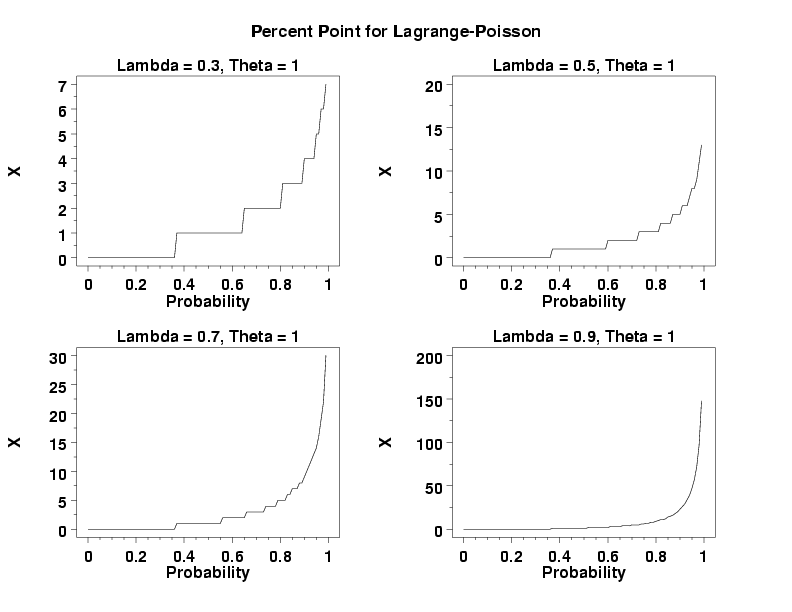
multiplot 2 2
.
title Lambda = 0.3, Theta = 1
plot lpoppf(p,0.3,1) for p = 0  0.01  0.99
.
title Lambda = 0.5, Theta = 1
plot lpoppf(p,0.5,1) for p = 0  0.01  0.99
.
title Lambda = 0.7, Theta = 1
plot lpoppf(p,0.7,1) for p = 0  0.01  0.99
.
title Lambda = 0.9, Theta = 1
plot lpoppf(p,0.9,1) for p = 0  0.01  0.99
.
end of multiplot
.
justification center
move 50 97
text Percent Point for Lagrange-Poisson
Date created: 6/20/2006 |
 and
and  denoting the shape parameters.