
|
|
DIWPPFName:
![G(p;q,beta) = {LOG(1-p)/LOG(q)]**(1/beta)
0 <= p < 1; 0 < q < 1; beta > 0](eqns/diwppf.gif)
with q and
<SUBSET/EXCEPT/FOR qualification> where <p> is a positive integer variable, number, or parameter in the interval (0,1); <q> is a number, parameter, or variable in the range (0,1) that specifies the first shape parameter; <beta> is a number, parameter, or variable that specifies the second shape parameter; <y> is a variable or a parameter (depending on what <x> is) where the computed discrete Weibull ppf value is stored; and where the <SUBSET/EXCEPT/FOR qualification> is optional.
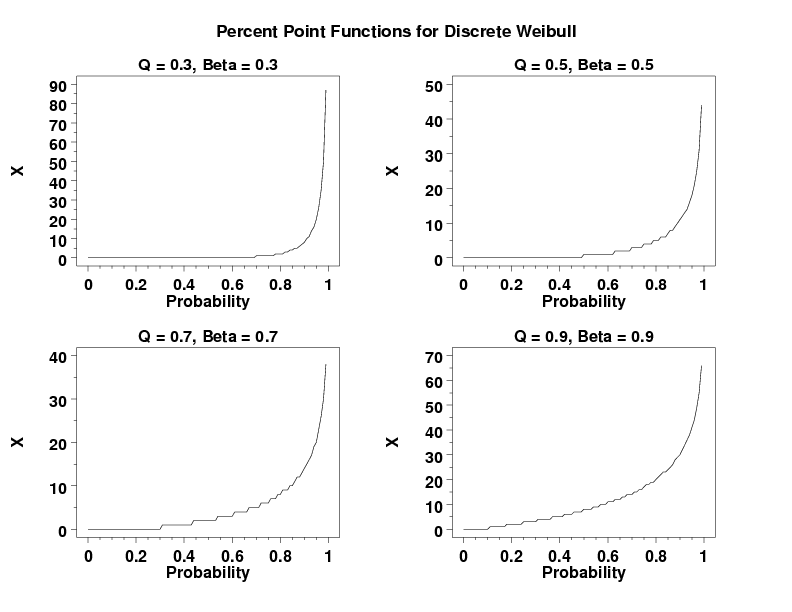
LET Y = DIWPPF(P,0.3,0.7) PLOT DIWPPF(P,0.6,0.4) FOR P = 0 0.01 0.99
Nakagawa and Osaki (1975), "The Discrete Weibull Distribution", IEEE Transactions on Reliability, R-24, pp. 300-301.
title size 3
tic label size 3
label size 3
legend size 3
height 3
x1label displacement 12
y1label displacement 15
.
multiplot corner coordinates 0 0 100 95
multiplot scale factor 2
label case asis
title case asis
case asis
tic offset units screen
tic offset 3 3
title displacement 2
x1label Probability
y1label X
.
xlimits 0 1
major xtic mark number 6
minor xtic mark number 3
line blank
spike on
.
multiplot 2 2
.
title Q = 0.3, Beta = 0.3
plot diwppf(p,0.3,0.3) for p = 0  0.01  0.99
.
title Q = 0.5, Beta = 0.5
plot diwppf(p,0.5,0.5) for p = 0  0.01  0.99
.
title Q = 0.7, Beta = 0.7
plot diwppf(p,0.7,0.7) for p = 0  0.01  0.99
.
title Q = 0.9, Beta = 0.9
plot diwppf(p,0.9,0.9) for p = 0  0.01  0.99
.
end of multiplot
.
justification center
move 50 97
text Percent Point Functions for Discrete Weibull
Date created: 11/16/2006 |
 denoting the shape parameters.