
|
|
GLSPPFName:

with The cumulative distribution function is computed using the following recurrence relation given on pages 228-229 of Consul and Famoye:
![p(x+1;theta,beta) = (beta - x/(x+1))*theta*(1-theta)^(beta-1)*
PROD[j=1 to x-1][(1+beta/(beta*x - j))*p(x;theta,beta)](eqns/glscdf.gif)
with
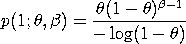
The percent point function is computed by summing the above recurence relation until the the specified probability is obtained.
<SUBSET/EXCEPT/FOR qualification> where <p> is a positive integer variable, number, or parameter in the range (0,1); <theta> is a number, parameter, or variable in the range (0,1) that specifies the first shape parameter; <beta> is a number, parameter, or variable that specifies the second shape parameter; <y> is a variable or a parameter (depending on what <x> is) where the computed generalized logarithmic series ppf value is stored; and where the <SUBSET/EXCEPT/FOR qualification> is optional.
LET Y = GLSPPF(P,0.3,1.6) PLOT GLSPPF(P,0.3,1.6) FOR P = 0 0.01 0.99
title size 3
tic label size 3
label size 3
legend size 3
height 3
x1label displacement 12
y1label displacement 15
.
multiplot corner coordinates 0 0 100 95
multiplot scale factor 2
label case asis
title case asis
case asis
tic offset units screen
tic offset 3 3
title displacement 2
x1label Probability
y1label X
.
xlimits 0 1
major xtic mark number 6
minor xtic mark number 3
.
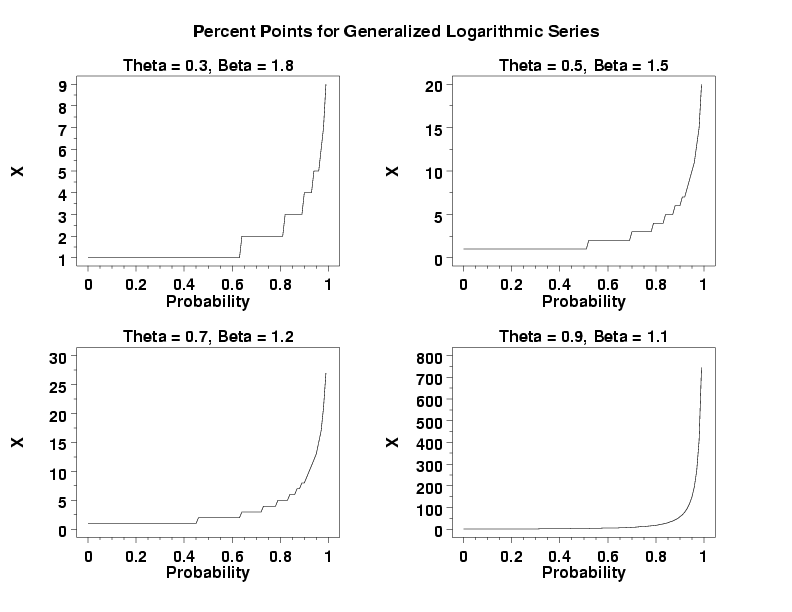
multiplot 2 2
.
title Theta = 0.3, Beta = 1.8
plot glsppf(p,0.3,1.8) for p = 0  0.01  0.99
.
title Theta = 0.5, Beta = 1.5
plot glsppf(p,0.5,1.5) for p = 0  0.01  0.99
.
title Theta = 0.7, Beta = 1.2
plot glsppf(p,0.7,1.2) for p = 0  0.01  0.99
.
title Theta = 0.9, Beta = 1.1
plot glsppf(p,0.9,1.1) for p = 0  0.01  0.99
.
end of multiplot
.
justification center
move 50 97
text Percent Points for Generalized Logarithmic Series
Date created: 8/23/2006 |
 and
and
 denoting the shape parameters.
