
|
|
EMPIRICAL QUANTILE FUNCTIONName:
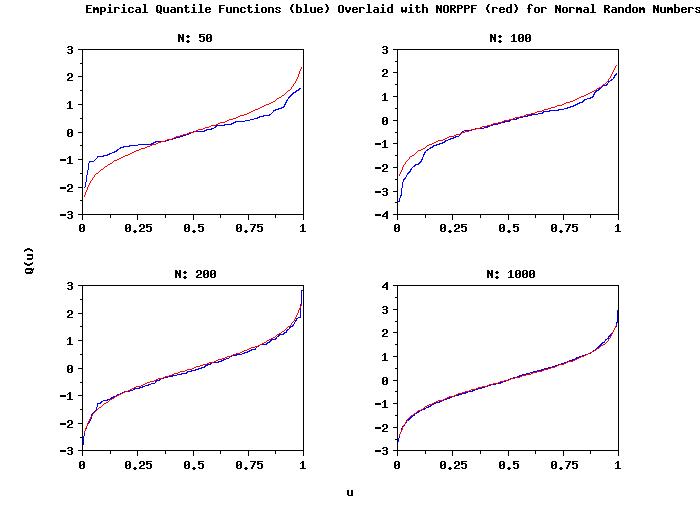
Given a set of ordered data, x1 ≤ x2 ... ≤ xn, an empirical estimate of the quantile function can be obtained from the following piecewise linear function
\( \frac{2j - 1}{2n} \le u \le \frac{2j + 1}{2n} \) This will be computed for a specified number of equi-spaced points between the lower and upper limits. Dataplot will use the number of points in the sample if this is greater than 1,000. Otherwise 1,000 points will be used.
<SUBSET/EXCEPT/FOR qualification> where <x> is the response variable; <y> is a variable containing the empirical quantile function; <u> is a variable containing the values where the empirical quantile function is computed; and where the <SUBSET/EXCEPT/FOR qualification> is optional.
LET Y U = EMPIRICAL QUANTILE FUNCTION X SUBSET X > 0
Parzen (1983), "Informative Quantile Functions and Identification of Probability Distribution Types", Technical Report No. A-26, Texas A&M University.
. Step 1:   Define some default plot control features
.
title offset 2
title case asis
case asis
label case asis
line color blue red
multiplot scale factor 2
multiplot corner coordinates 5 5 95 95
.
. Step 2:   Create 50, 100, 200, and 1000 normal random numbers and
.           compute the empirical quantile funciton
.
let nv = data 50 100 200 1000
let p = sequence 0.01 0.01 .99
let y2 = norppf(p)
.
. Step 3:   Loop through the four cases and compute and plot the
.           empirical quantile funciton with overlaid NORPPF
.
multiplot 2 2
loop for k = 1 1 4
    let n = nv(k)
    let x = norm rand numb for i = 1 1 n
    let y u = empirical quantile function x
    title N: ^n
    plot y u and
    plot y2 p
end of loop
end of multiplot
.
justification center
move 50 97
text Empirical Quantile Functions (blue) Overlaid with ...
NORPPF (red) for Normal Random Numbers
move 50 5
text u
direction vertical
move 5 50
text Q(u)
|
Privacy
Policy/Security Notice
NIST is an agency of the U.S.
Commerce Department.
Date created: 07/20/2017 | |||||||||||||||||||