
|
|
BTAPPFName:
 , and
k initial customers, the Borel-Tanner distribution is
the distribution of the total number of customers served
before the queue vanishes. , and
k initial customers, the Borel-Tanner distribution is
the distribution of the total number of customers served
before the queue vanishes.
The probability mass function of the Borel-Tanner distribution is

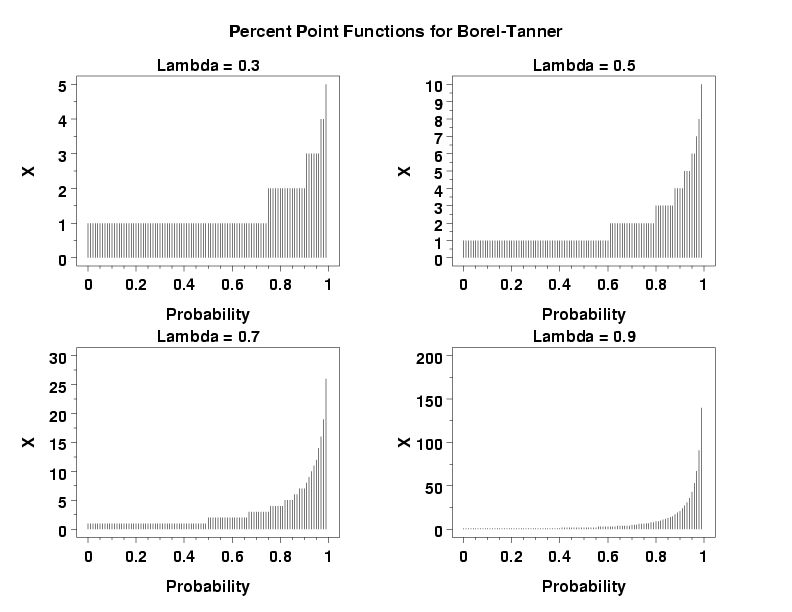
with The cumulative distribution function is computed by summing the probability mass function. The percent point function is the inverse of the cumulative distribution function and is obtained by computing the cumulative distribution function until the specified probability is reached.
<SUBSET/EXCEPT/FOR qualification> where <p> is a variable, number, or parameter in the range (0,1); <lambda> is a number or parameter in the range (0,1) that specifies the first shape parameter; <k> is a number or parameter denoting a positive integer that specifies the first shape parameter; <y> is a variable or a parameter where the computed Borel-Tanner ppf value is stored; and where the <SUBSET/EXCEPT/FOR qualification> is optional.
LET Y = BTAPPF(P1,0.3,2) PLOT BTAPPF(P,0.4,2) FOR P = 0 0.01 0.99
Johnson, Kotz, and Kemp (1992), "Univariate Discrete Distributions", Second Edition, Wiley, pp. 394-396.
multiplot corner coordinates 0 0 100 95
multiplot scale factor 2
label case asis
title case asis
case asis
tic offset units screen
tic offset 3 3
title displacement 2
y1label Probability
x1label X
.
xlimits 0 1
major xtic mark number 6
minor xtic mark number 3
line blank
spike on
.
multiplot 2 2
.
title Lambda = 0.3
plot btappf(p,0.3,1) for p = 0  0.01  0.99
.
title Lambda = 0.5
plot btappf(p,0.5,1) for p = 0  0.01  0.99
.
title Lambda = 0.7
plot btappf(p,0.7,1) for p = 0  0.01  0.99
.
title Lambda = 0.9
plot btappf(p,0.9,1) for p = 0  0.01  0.99
.
end of multiplot
.
justification center
move 50 97
text Percent Point Functions for Borel-Tanner
Date created: 6/5/2006 |
 and k denoting the shape parameters. The k shape
parameter is a positive integer and
and k denoting the shape parameters. The k shape
parameter is a positive integer and