
|
|
HARMNUMBName:
![H(n,m) = SUM[k = 1 to n][1/k**m]](eqns/harmnumb.gif)
The case where m = 1 is referred to as the harmonic number and has the formula
![H(n) = SUM[k = 1 to n][1/k]](eqns/harmnum2.gif)
The m parameter is restricted to values greater than 1.
where <n> is a number, variable, or parameter (> 1); <y> is a variable or a parameter (depending on what <x> is) where the computed harmonic number is stored; and where the <SUBSET/EXCEPT/FOR qualification> is optional. This syntax computes the harmonic number.
<SUBSET/EXCEPT/FOR qualification> where <n> is a positive integer number, parameter or variable; <m> is a number, parmeter, or variable (> 1); <y> is a variable or a parameter (depending on what <x> is) where the computed harmonic number is stored; and where the <SUBSET/EXCEPT/FOR qualification> is optional. This syntax computes the generalized harmonic number.
LET A = HARMNUMB(200,1.5)
"AMS 55: Handbook of Mathematical Functions", Abramowitz and Stegun, Eds., Washington, DC, National Bureau of Standards, 1964.
multiplot corner coordinates 0 0 100 95
multiplot scale factor 2
case asis
label case asis
title case asis
tic offset units screen
tic offset 3 3
title displacement 2
y1label displacement 17
x1label displacement 12
x1label N
y1label Harmonic Number
.
multiplot 2 2
.
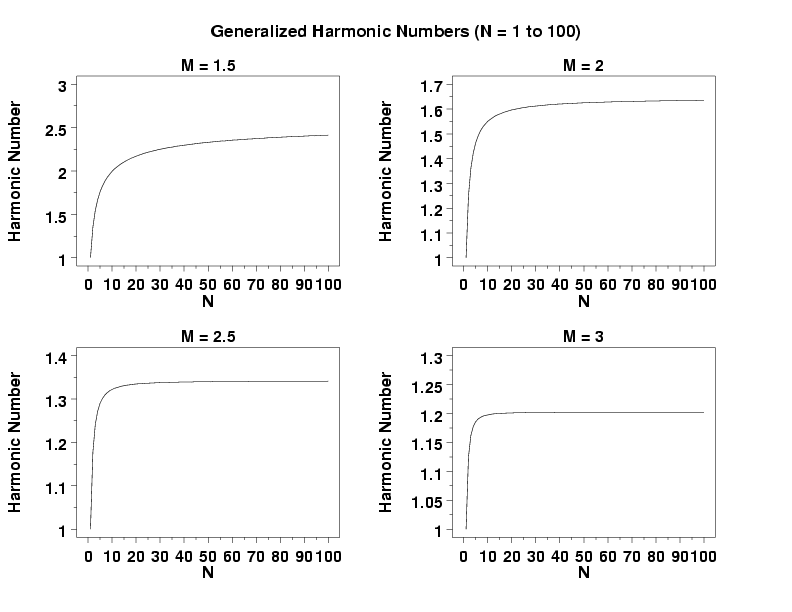
let m = 1.5
title M = ^m
plot harmnumb(n,m) for n = 1 1 100
.
let m = 2.0
title M = ^m
plot harmnumb(n,m) for n = 1 1 100
.
let m = 2.5
title M = ^m
plot harmnumb(n,m) for n = 1 1 100
.
let m = 3.0
title M = ^m
plot harmnumb(n,m) for n = 1 1 100
.
end of multiplot
.
justification center
move 50 97
text Generalized Harmonic Numbers (N = 1 to 100)
Date created: 6/12/2006 |