
|
|
F TESTName:
The two-sided hypothesis test is:
Note that for the upper tailed test, the larger of \( s_1 \) and \( s_2 \) is in the numerator and the smaller is in the denominator of the test statistic. The upper tailed hypothesis test is:
To specify the upper tailed test (the default), enter
To specify the two-tailed test, enter
The test conclusions are given for several values of alpha. Note that the F test is known to be quite senstive to departures from normality. There have been several proposals in the literature to make this test more robust. This is discussed further in the "Note:" section below.
where <y1> is the first response variable; <y2> is the second response variable; and where the <SUBSET/EXCEPT/FOR qualification> is optional.
where <y1> ... <yk> is a list of two or more response variables; and where the <SUBSET/EXCEPT/FOR qualification> is optional. This syntax performs all the two-way F tests for the listed variables. This syntax supports the TO syntax.
F TEST Y1 Y2 Y3 F TEST Y1 TO Y10 F TEST Y1 Y2 SUBSET Y2 > 0
SET F TEST TYPE TWO SIDED
SET F TEST TYPE UPPER TAILED
Shoemaker (2003) proposed the following adjustment to the degrees of freedom to make the F test more robust against non-normality. The degrees of freedom are
where
\( \sigma^{2} = \frac{(n_{1} - 1) s_{1}^{2} + (n_{2} - 1) s_{2}^{2}} {n_{1} + n_{2}} \) with \( y_{ij} \), \( n_{i} \), \( s_{i} \) and \( \bar{y}_{i} \) denoting the data, the sample size, the standard deviation and the mean, respectively, of the i-th variable. This typically results in fractional degrees of freedom. The Dataplot FCDF, FPDF and FPPF routines were updated to support fractional degrees of freedom (fractional degrees of freedom less than 1 are set to 1). The justification and derivation of this modification is given in Shoemaker's paper. Simulations by Shoemaker indicated that the standard F test tends to be too conservative for light tailed distributions and too liberal for heavy tailed and skewed distributions. Using the Shoemaker modifications for degrees of freedom generally had good coverage properties with the exception of heavily skewed distributions with small samples where it was still too liberal. Bonett (2006) suggested that rounding the numerator degrees of freedom up to the nearest integer degrees of freedom and rounding the denominator degrees of freedom down to the nearest integer degrees of freedom (but not less than 1) prevented some anomalous behavior while reducing coverage performance only slightly. Bonett proposed the following statistic:
where
The parameter c is a small sample adjustment to help equalize the tail probabilities. It equals 1 when n1 and n2 equal and approaches 1 as n1 and n2 get large. For unequal sample sizes, the value of the test statistic will vary slightly depending on the value of alpha. The above formula is for the variance. For the standard deviation, take the square root. This test statistic is compared to a standard normal distribution. The justification and derivation of this test is given in the Bonett paper. Based on his simulations, he claims this method improves somewhat on the Shoemaker modification for heavy-tailed (particularly skewed) distributions. To specify Shoemaker's modification with fractional degrees of freedom, enter
To specify Shoemaker's modification with integral degrees of freedom as suggested by Bonett, enter
To specify Bonett's method, enter
\( \sigma^{2} = \frac{(n_{1} - 1) s_{1}^{2} + (n_{2} - 1) s_{2}^{2} + ... + (n_{k} - 1) s_{k}} {n_{1} + n_{2} + ... + n_{k}} \) To use these values, enter the commands
SET SHOEMAKER F TEST POOLED VARIANCE <value> To reset the default of Dataplot computing these from the two groups being tested, enter
SET SHOEMAKER F TEST POOLED VARIANCE 0
For an upper tailed test, the following parameters are saved
For a two sided test, the following are saved
If the Bonett method is specified, a two sided interval will always be used. Also, STATNU1, STATNU2 and POOLSD will not be saved.
LET STATCDF = F TEST CDF Y1 Y2 LET PVALUE = F TEST PVALUE Y1 Y2 In addition to the above LET commands, built-in statistics are supported for 30+ different commands (enter HELP STATISTICS for details).
Shoemaker (2003), "Fixing the F-Test for Equal Variances," The American Statistician, Vol. 57, pp. 105-114. Bonett (2006), "Robust Confidence Intervals for a Ratio of Standard Deviations," Applied Pyschological Measurement, Vol. 30, No. 5, pp. 432-439.
2023/06: Added support for Shoemaker and Bonett modifications 2023/06: Added support for two sided tests
. Step 1: Read the data . skip 25 read shoemake.dat bottom mid surface let y x = stack bottom mid surface let temp1 = cross tabulate mean y x let temp2 = (y - temp1)**4 let num = sum temp2 let den = size y let mu4 = num/den let y1var = variance bottom let y2var = variance mid let y3var = variance surface let n1 = size bottom let n2 = size mid let n3 = size surface let num = (n1 - 1)*y1var + (n2 -1)*y2var + (n3 - 1)*y3var let poolvar = num/den . . Step 2: Generate a box plot . character box plot line box plot xlimits 1 3 major xtic mark number 3 minor xtic mark number 0 xtic mark offset 0.5 0.5 x1tic mark label format alpha x1tic mark label content Bottom Middepth Surface tic mark label case asis set box plot fences on box plot y x 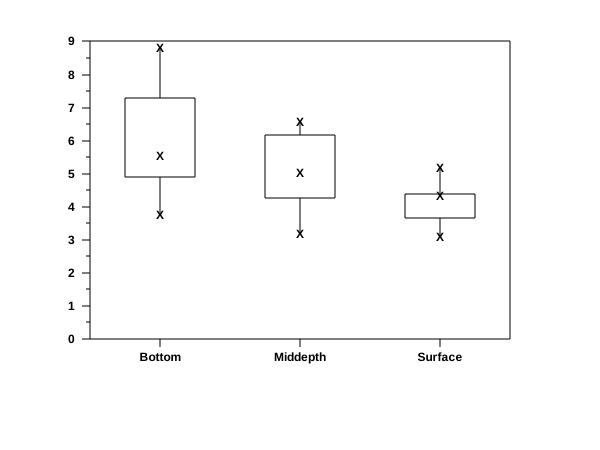
.
. Step 3:   Default F-test
.
set f test degrees of freedom default
print "Standard F Test"
f test bottom mid
let statval = f test        bottom mid
let statcdf = f test cdf    bottom mid
let pvalue  = f test pvalue bottom mid
print statval statcdf pvalue
The following output is generated
Standard F Test

             Two Sample F-Test for Equal Standard Deviations

 First Response Variable:  BOTTOM
 Second Response Variable: MID

 H0: Sigma1/Sigma2 = 1
 Ha: Sigma1/Sigma2 > 1

 Sample One Summary Statistics:
 Number of Observations:                              10
 Sample Mean:                                    6.02100
 Sample Standard Deviation:                      1.58184

 Sample Two Summary Statistics:
 Number of Observations:                              10
 Sample Mean:                                    5.01900
 Sample Standard Deviation:                      1.10440

 Test:
 Standard Deviation (Numerator):                 1.58184
 Standard Deviation (Denomerator):               1.10440
 Degrees of Freedom (Numerator):                       9
 Degrees of Freedom (Denomerator):                     9
 Pooled Standard Deviation:                      1.36417
 F-Test Statistic Value:                         2.05152
 F-Test CDF Value:                               0.85031
 F-Test P-Value:                                 0.14969


             Conclusions (Upper 1-Tailed Test)

 H0: sigma1/sigma2 = 1; Ha: sigma1/sigma2 > 1
 ------------------------------------------------------------
                                                         Null
    Significance           Test       Critical     Hypothesis
           Level      Statistic    Region (>=)     Conclusion
 ------------------------------------------------------------
           50.0%        2.05152        1.00000         REJECT
           75.0%        2.05152        1.59090         REJECT
           90.0%        2.05152        2.44034         ACCEPT
           95.0%        2.05152        3.17889         ACCEPT
           97.5%        2.05152        4.02599         ACCEPT
           99.0%        2.05152        5.35113         ACCEPT
           99.9%        2.05152       10.10663         ACCEPT


 THE COMPUTED VALUE OF THE CONSTANT STATVAL       =    2.051516


 THE COMPUTED VALUE OF THE CONSTANT STATCDF       =   0.8503082


 THE COMPUTED VALUE OF THE CONSTANT PVALUE        =   0.1496918


 PARAMETERS AND CONSTANTS--

    STATVAL --        2.05152
    STATCDF --        0.85031
    PVALUE  --        0.14969
.
. Step 4:   Shoemaker F-test
.
set f test degrees of freedom shoemaker
print "Shoemaker degrees of freedom F Test"
f test bottom mid
print "Use pooled location and variance for Shoemaker"
set shoemaker f test pooled variance poolvar
set shoemaker f test pooled mu       mu4
f test bottom mid
print "Shoemaker rounded degrees of freedom F Test"
set f test degrees of freedom shoemaker rounded
f test bottom mid
set shoemaker f test pooled variance 0
set shoemaker f test pooled mu
The following output is generated
Shoemaker degrees of freedom F Test

             Two Sample F-Test for Equal Standard Deviations
             (Use Shoemaker Modifications to Degrees of Freedom)

 First Response Variable:  BOTTOM
 Second Response Variable: MID

 H0: Sigma1/Sigma2 = 1
 Ha: Sigma1/Sigma2 > 1

 Sample One Summary Statistics:
 Number of Observations:                              10
 Sample Mean:                                    6.02100
 Sample Standard Deviation:                      1.58184

 Sample Two Summary Statistics:
 Number of Observations:                              10
 Sample Mean:                                    5.01900
 Sample Standard Deviation:                      1.10440

 Test:
 Standard Deviation (Numerator):                 1.58184
 Standard Deviation (Denomerator):               1.10440
 Degrees of Freedom (Numerator):                12.42315
 Degrees of Freedom (Denomerator):              12.42315
 Pooled Standard Deviation:                      1.36417
 F-Test Statistic Value:                         2.05152
 F-Test CDF Value:                               0.89036
 F-Test P-Value:                                 0.10964


             Conclusions (Upper 1-Tailed Test)

 H0: sigma1/sigma2 = 1; Ha: sigma1/sigma2 > 1
 ------------------------------------------------------------
                                                         Null
    Significance           Test       Critical     Hypothesis
           Level      Statistic    Region (>=)     Conclusion
 ------------------------------------------------------------
           50.0%        2.05152        1.00000         REJECT
           75.0%        2.05152        1.47952         REJECT
           90.0%        2.05152        2.11767         ACCEPT
           95.0%        2.05152        2.63791         ACCEPT
           97.5%        2.05152        3.20501         ACCEPT
           99.0%        2.05152        4.04346         ACCEPT
           99.9%        2.05152        6.73615         ACCEPT

Use pooled location and variance for Shoemaker

 THE FORTRAN COMMON SCALAR SHOEF    HAS JUST BEEN SET TO   0.1251562E+01

 THE FORTRAN COMMON SCALAR SHOEF    HAS JUST BEEN SET TO   0.4585221E+01

             Two Sample F-Test for Equal Standard Deviations
             (Use Shoemaker Modifications to Degrees of Freedom)

 First Response Variable:  BOTTOM
 Second Response Variable: MID

 H0: Sigma1/Sigma2 = 1
 Ha: Sigma1/Sigma2 > 1

 Sample One Summary Statistics:
 Number of Observations:                              10
 Sample Mean:                                    6.02100
 Sample Standard Deviation:                      1.58184

 Sample Two Summary Statistics:
 Number of Observations:                              10
 Sample Mean:                                    5.01900
 Sample Standard Deviation:                      1.10440

 Test:
 Standard Deviation (Numerator):                 1.58184
 Standard Deviation (Denomerator):               1.10440
 Degrees of Freedom (Numerator):                 9.30474
 Degrees of Freedom (Denomerator):               9.30474
 Pooled Standard Deviation:                      1.36417
 F-Test Statistic Value:                         2.05152
 F-Test CDF Value:                               0.85454
 F-Test P-Value:                                 0.14546


             Conclusions (Upper 1-Tailed Test)

 H0: sigma1/sigma2 = 1; Ha: sigma1/sigma2 > 1
 ------------------------------------------------------------
                                                         Null
    Significance           Test       Critical     Hypothesis
           Level      Statistic    Region (>=)     Conclusion
 ------------------------------------------------------------
           50.0%        2.05152        1.00000         REJECT
           75.0%        2.05152        1.57799         REJECT
           90.0%        2.05152        2.40166         ACCEPT
           95.0%        2.05152        3.11256         ACCEPT
           97.5%        2.05152        3.92318         ACCEPT
           99.0%        2.05152        5.18299         ACCEPT
           99.9%        2.05152        9.64550         ACCEPT

Shoemaker rounded degrees of freedom F Test

 THE FORTRAN COMMON CHARACTER VARIABLE F   TEST HAS JUST BEEN SET TO SHO2

             Two Sample F-Test for Equal Standard Deviations
             (Shoemaker Modifications with Rounded Degrees of Freedom)

 First Response Variable:  BOTTOM
 Second Response Variable: MID

 H0: Sigma1/Sigma2 = 1
 Ha: Sigma1/Sigma2 > 1

 Sample One Summary Statistics:
 Number of Observations:                              10
 Sample Mean:                                    6.02100
 Sample Standard Deviation:                      1.58184

 Sample Two Summary Statistics:
 Number of Observations:                              10
 Sample Mean:                                    5.01900
 Sample Standard Deviation:                      1.10440

 Test:
 Standard Deviation (Numerator):                 1.58184
 Standard Deviation (Denomerator):               1.10440
 Degrees of Freedom (Numerator):                      10
 Degrees of Freedom (Denomerator):                     9
 Pooled Standard Deviation:                      1.37649
 F-Test Statistic Value:                         2.05152
 F-Test CDF Value:                               0.85275
 F-Test P-Value:                                 0.14725


             Conclusions (Upper 1-Tailed Test)

 H0: sigma1/sigma2 = 1; Ha: sigma1/sigma2 > 1
 ------------------------------------------------------------
                                                         Null
    Significance           Test       Critical     Hypothesis
           Level      Statistic    Region (>=)     Conclusion
 ------------------------------------------------------------
           50.0%        2.05152        1.00774         REJECT
           75.0%        2.05152        1.58634         REJECT
           90.0%        2.05152        2.41632         ACCEPT
           95.0%        2.05152        3.13728         ACCEPT
           97.5%        2.05152        3.96387         ACCEPT
           99.0%        2.05152        5.25654         ACCEPT
           99.9%        2.05152        9.89430         ACCEPT
.
. Step 5:   Bonett
.
set f test degrees of freedom bonett
print "Bonett method"
f test bottom mid
The following output is generated
Bonett method

             Two Sample F-Test for Equal Standard Deviations
                     (Bonett Method for Robustness)

 First Response Variable:  BOTTOM
 Second Response Variable: MID

 H0: Sigma1/Sigma2 = 1
 Ha: Sigma1/Sigma2 > 1

 Sample One Summary Statistics:
 Number of Observations:                              10
 Sample Mean:                                    6.02100
 Sample Standard Deviation:                      1.58184

 Sample Two Summary Statistics:
 Number of Observations:                              10
 Sample Mean:                                    5.01900
 Sample Standard Deviation:                      1.10440

 Test:
 Standard Deviation (Numerator):                 1.58184
 Standard Deviation (Denomerator):               1.10440
 Test Statistic Value (alpha = 0.05):            3.23288
 Test CDF Value (alpha = 0.05):                  0.99939
 Test P-Value (alpha = 0.05):                    0.00123


             Conclusions

 H0: sigma1/sigma2 = 1; Ha: sigma1/sigma2 <> 1
 ---------------------------------------------------------------------------
                                         Lower          Upper           Null
    Significance           Test       Critical       Critical     Hypothesis
           Level      Statistic    Region (<=)    Region (>=)     Conclusion
 ---------------------------------------------------------------------------
           50.0%        3.23288       -0.67449        0.67449         REJECT
           80.0%        3.23288       -1.28155        1.28155         REJECT
           90.0%        3.23288       -1.64485        1.64485         REJECT
           95.0%        3.23288       -1.95996        1.95996         REJECT
           99.0%        3.23288       -2.57583        2.57583         REJECT
           99.9%        3.23288       -3.29053        3.29053         ACCEPT
Date created: 06/07/2023 |
Last updated: 06/07/2023 Please email comments on this WWW page to [email protected]. | |||||||||||||||||||||||||||||||||||||||||||||||||||||||||||||||||||||||||||||||||||||||||||||||||||||||||||||||||||||||||||||||||||||||||||||||||||||||