|
|
DIFFERENCE OF RELATIVE VARIANCEName:
with s2 and \( \bar{x} \) denoting the variance and the mean, respectively. Some analysts prefer to call this the percent relative variance and the value obtained without multiplying by 100 the relative variance. If this is your preference, simply divide the obtained value by 100 with the LET command. For the difference of relative variances, the relative variance is computed for each of two samples then their difference is taken.
<SUBSET/EXCEPT/FOR qualification> where <y1> is the first response variable; <y2> is the first response variable; <par> is a parameter where the computed difference of the relative variances is stored; and where the <SUBSET/EXCEPT/FOR qualification> is optional.
LET A = DIFFERENCE OF RELATIVE VARIANCE Y1 Y2 SUBSET X > 1
SKIP 25
READ IRIS.DAT Y1 TO Y4 X
.
LET A = DIFFERENCE OF RELATIVE VARIANCE Y1 Y2
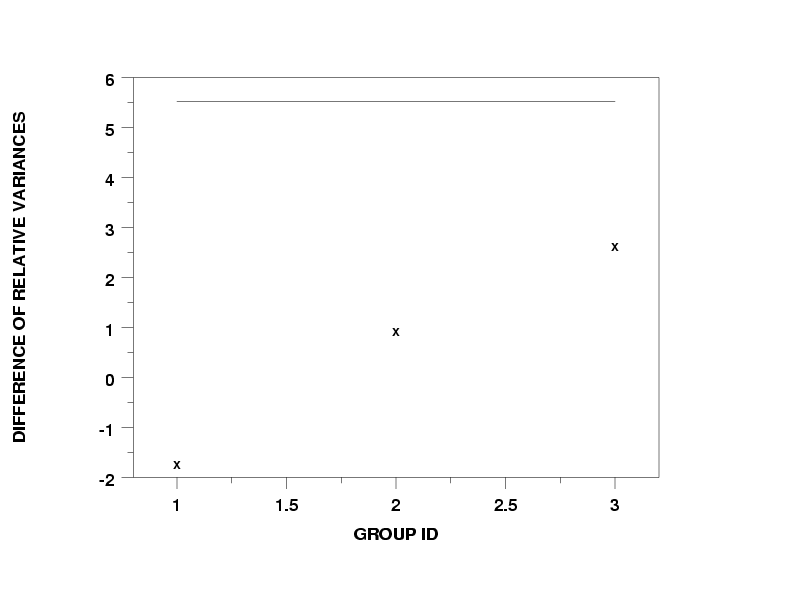
TABULATE DIFFERENCE OF RELATIVE VARIANCE Y1 Y2 X
.
XTIC OFFSET 0.2 0.2
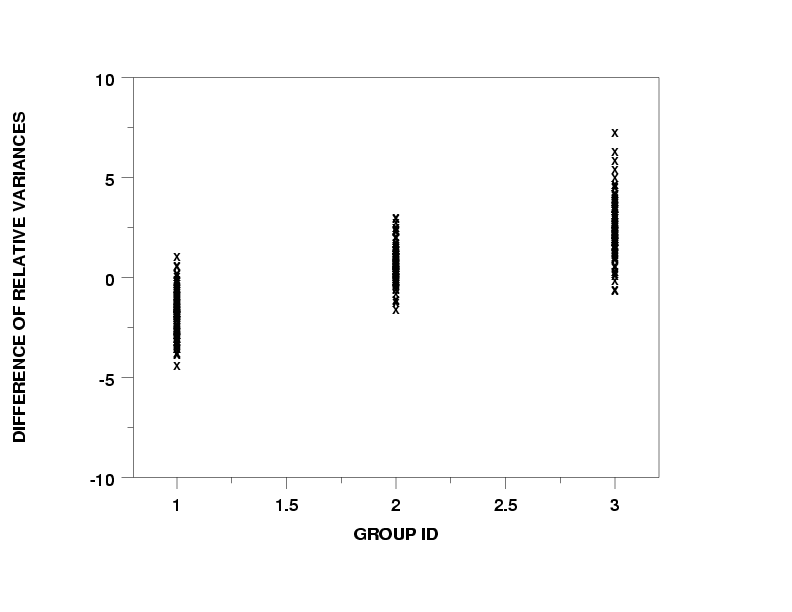
X1LABEL GROUP ID
Y1LABEL DIFFERENCE OF RELATIVE VARIANCE
CHAR X
LINE BLANK
DIFFERENCE OF RELATIVE VARIANCE PLOT Y1 Y2 X
CHAR X ALL
LINE BLANK ALL
BOOTSTRAP DIFFERENCE OF RELATIVE VARIANCE PLOT Y1 Y2 X
Dataplot generated the following output.
       *****************************************************
       **  LET A = DIFFERENCE OF RELATIVE VARIANCE Y1 Y2  **
       *****************************************************


 THE COMPUTED VALUE OF THE CONSTANT A             =  0.55207367E+01


       ********************************************************
       **  TABULATE DIFFERENCE OF RELATIVE VARIANCE Y1 Y2 X  **
       ********************************************************


                 *    Y1       AND Y2
     X           *    DIFFERENCE OF RELATIVE VARIANCES
 **********************************************
     1.00000     *    -1.70965
     2.00000     *    0.933569
     3.00000     *     2.64045

       GROUP-ID AND STATISTIC WRITTEN TO FILE DPST1F.DAT
|
Privacy
Policy/Security Notice
NIST is an agency of the U.S.
Commerce Department.
Date created: 03/27/2003 | ||||||||||||||||||||