
|
|
BNBPPFName:
 and and
 and k.
and ,
the resulting distribution is referred to as a
beta-negative binomial distribution. For a standard
negative binomial distribution, p is assumed to be fixed
for successive trials. For the beta-negative binomial
distribution, the value of p changes for each trial.
The formula for the beta-negative binomial probability mass function is
![P(x;alpha,beta,k) =
[Gamma(beta+alpha)*Gamma(k+beta)*Gamma(x+k)*Gamma(x+alpha)]/
[Gamma(k)*Gamma(beta)*Gamma(alpha)*Gamma(x+1)*Gamma(x+k_alpha+beta)]
x = 0, 1, 2, ...; alpha, beta > 0; k is a positive integer](eqns/bnbpdf.gif)
with Note that there are a number of different parameterizations and formulations of this distribution in the literature. We use the above formulation because it makes clear the relation between the beta-negative binomial and the negative binomial distributions. It also demonstrates the relation between the beta-negative binomial and the beta-binomial and beta-geometric distributions. It also provides a computationally convenient formula since the beta-negative binomial can be computed as the sums and differences of log gamma functions. Dataplot compumtes the cumulative distribution function using the following recurrence relation derived by Hesselager:
![p(x;alpha,beta,k) = p(x-1;alpha,beta,k)*[x+(k-1)]*[x+(alpha-1)]/
[x*(x+(alpha+beta+k-1))]](eqns/bnbcdf.gif)
Dataplot computes the percent point function by summing the cumulative distribution function until the specified probability is obtained.
<SUBSET/EXCEPT/FOR qualification> where <x> is a number, parameter, or variable in the interval (0,1); <alpha> is a number, parameter, or variable that specifies the first shape parameter; <beta> is a number, parameter, or variable that specifies the second shape parameter; <k> is a number, parameter, or variable that specifies the third shape parameter; <y> is a variable or a parameter (depending on what <p> is) where the computed beta-negative binomial ppf value is stored; and where the <SUBSET/EXCEPT/FOR qualification> is optional.
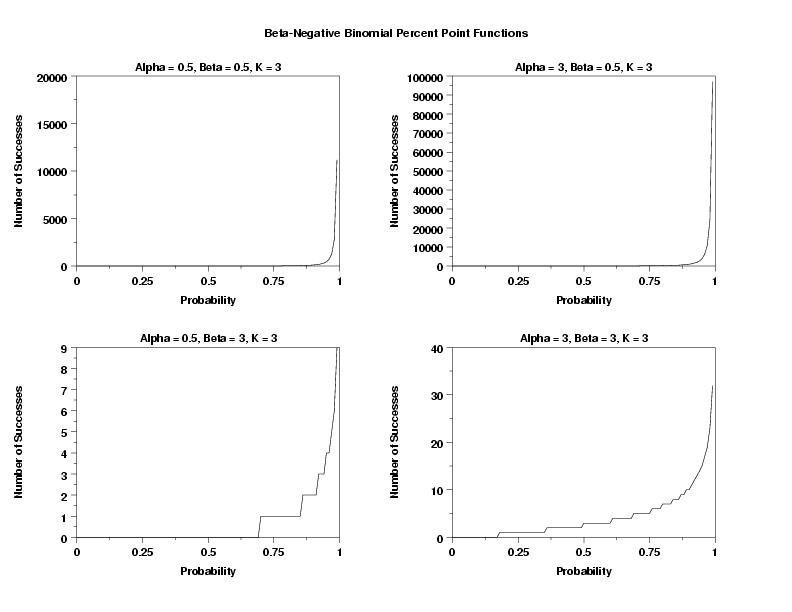
LET A = BNBPPF(P,2.1,4,2.5) PLOT BNBPPF(P,ALPHA,BETA,K) FOR P = 0 0.01 0.99
Irwin developed the generalized Waring distribution based on a generalization of the Waring expansion. The generalized Waring distribution is a re-parameterized beta-negative binomial distribution. Irwin's uses the parameterization
= a
= c - a
k = k
J. O. Irwin (1975), "The Generalized Waring Distribution Part 1", Journal of the Royal Statistical Society, Series A, 138, pp. 18-31. J. O. Irwin (1975), "The Generalized Waring Distribution Part 2", Journal of the Royal Statistical Society, Series A, 138, pp. 204-227. J. O. Irwin (1975), "The Generalized Waring Distribution Part 3", Journal of the Royal Statistical Society, Series A, 138, pp. 374-378. Johnson, Kotz, and Kemp (1992), "Univariate Discrete Distributions", Second Edition, Wiley, chapter 6. Luc Devroye (1992), "Random Variate Generation for the Digamma and Trigamma Distributions", Journal of Statistical Computation and Simulation", Vol. 43, pp. 197-216.
TITLE CASE ASIS
LABEL CASE ASIS
Y1LABEL Number of Successes
X1LABEL Probability
TITLE DISPLACEMENT 2
Y1LABEL DISPLACEMENT 15
X1LABEL DISPLACEMENT 12
.
MULTIPLOT 2 2
MULTIPLOT CORNER COORDINATES 0 0 100 95
MULTIPLOT SCALE FACTOR 2
.
LET K = 3
TITLE Alpha = 0.5, Beta = 0.5, K = 3
PLOT BNBPPF(P,0.5,0.5,K) FOR P = 0  0.01  0.99
.
TITLE Alpha = 3, Beta = 0.5, K = 3
PLOT BNBPPF(P,3.0,0.5,K) FOR P = 0  0.01  0.99
.
TITLE Alpha = 0.5, Beta = 3, K = 3
PLOT BNBPPF(P,0.5,3.0,K) FOR P = 0  0.01  0.99
.
TITLE Alpha = 3, Beta = 3, K = 3
PLOT BNBPPF(P,3.0,3.0,K) FOR P = 0  0.01  0.99
.
END OF MULTIPLOT
.
CASE ASIS
JUSTIFICATION CENTER
MOVE 50 97
TEXT Beta-Negative Binomial Percent Point Functions
Date created: 8/23/2006 |
 denoting the gamma function.